live · Active Beta · 2026
Project Nexus
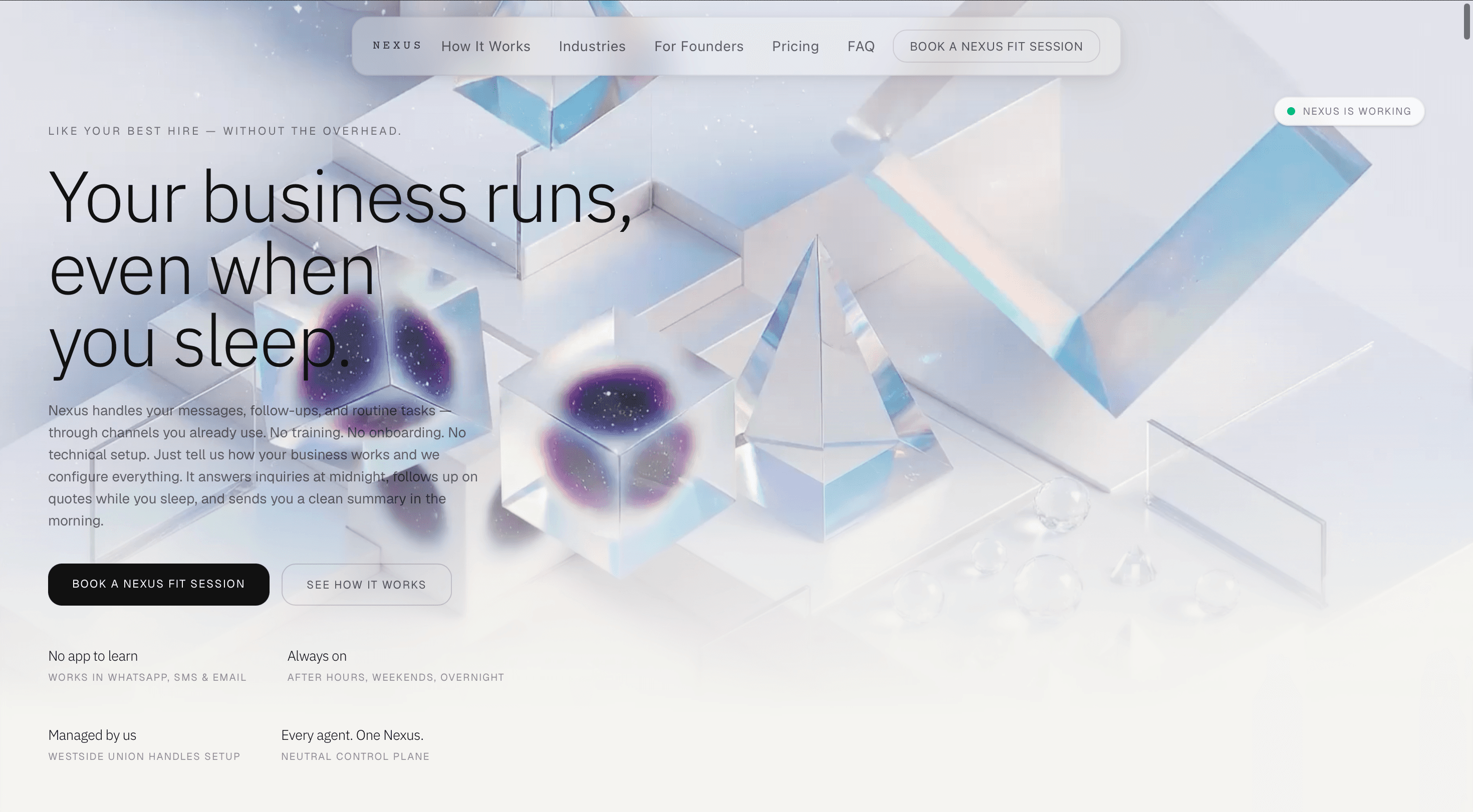
A modular AI framework system evolved into a configurable, messaging-first managed assistant for business owners. Currently in active beta deployment with business clients, coordinating specialized capabilities, shared business context, human approvals, and safe fallback behind familiar channels like WhatsApp, SMS, and email.
Problem
Business owners lose hours every evening to repetitive coordination across inboxes and reviews, yet existing tools require complex technical management or produce unvetted, risky automated actions.
Role & Contribution
Founder, Product Strategy, System Architecture, Experience Design, Creative Direction
Duration
Active Client Beta Deployment
Status / Outcome
live
Context: The business owner’s coordination dilemma
Most local-business owners do not spend their days thinking about AI infrastructure. They think about customer messages accumulating while they are on the floor, online reviews waiting a week for a response, inquiries going cold after hours, and administrative follow-ups that follow them home late into the evening.
When owners seek solutions, they encounter two extremes: rigid, generic chatbot widgets that lack true business context and risk embarrassing the brand, or complicated enterprise AI platforms that require becoming a full-time prompt engineer and infrastructure administrator.
Project Nexus began with a clear systems-design question: How can a business leverage specialized, rapidly evolving AI capabilities without forcing the owner to manage separate tools, fragmented context, inconsistent permissions, or technical complexity?
Product evolution: From modular framework to messaging-first assistant
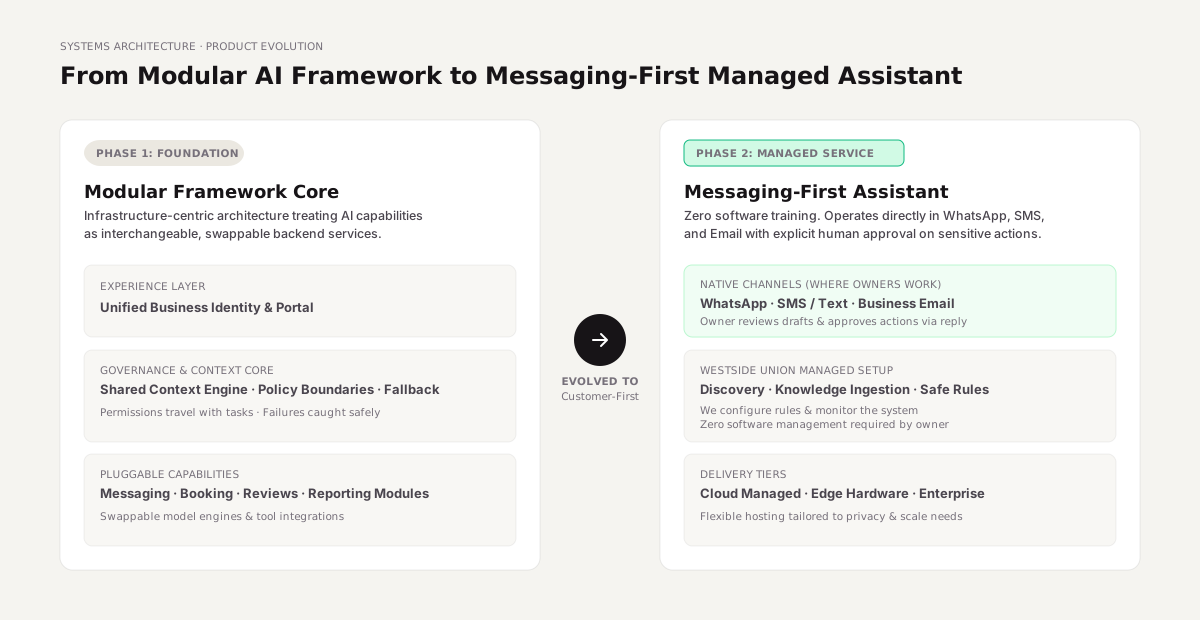
Project Nexus initially took shape as an architectural framework: a neutral coordination plane designed to manage specialized capability modules, context stores, permission scopes, and fallback chains behind a unified business identity. While technically robust, direct research with small-business owners revealed a critical insight:
“Owners do not want another browser tab or dashboard to log into. They want agreed work to move forward in the tools and communication channels they already use every day.”
This led to a major strategic pivot: evolving the modular framework into a configurable, messaging-first managed assistant. Instead of requiring clients to learn software or configure pipelines, Westside Union handles the discovery, knowledge ingestion, and governance rules. Nexus then interacts directly through native messaging channels (WhatsApp, SMS, Email), bringing autonomy and review into the owner’s natural workflow.
Core systems principles
Five foundational principles govern how Nexus balances autonomy, reliability, and human control:
1. One Coherent Identity
The client and their customers interact with one consistent brand voice. Underlying capability modules remain swappable infrastructure behind the scenes.
2. Shared Canonical Context
Business operating hours, policies, pricing guidelines, and customer history live in one shared context layer, preventing repetitive re-explanation.
3. Scoped Permissions & Review
Autonomy without anxiety. Routine inquiries resolve automatically within bounds, while sensitive or public-facing actions pause for explicit owner sign-off.
4. Visible Plain-Language History
Owners receive daily digest summaries and transparent activity trails in human terms—not diagnostic log dumps.
5. Safe Fallback & Resilience
If a third-party tool or provider encounters a rate limit or outage, tasks hold safely in queue rather than failing silently or hallucinating.
Task state lifecycle & the human-in-the-loop approval gate
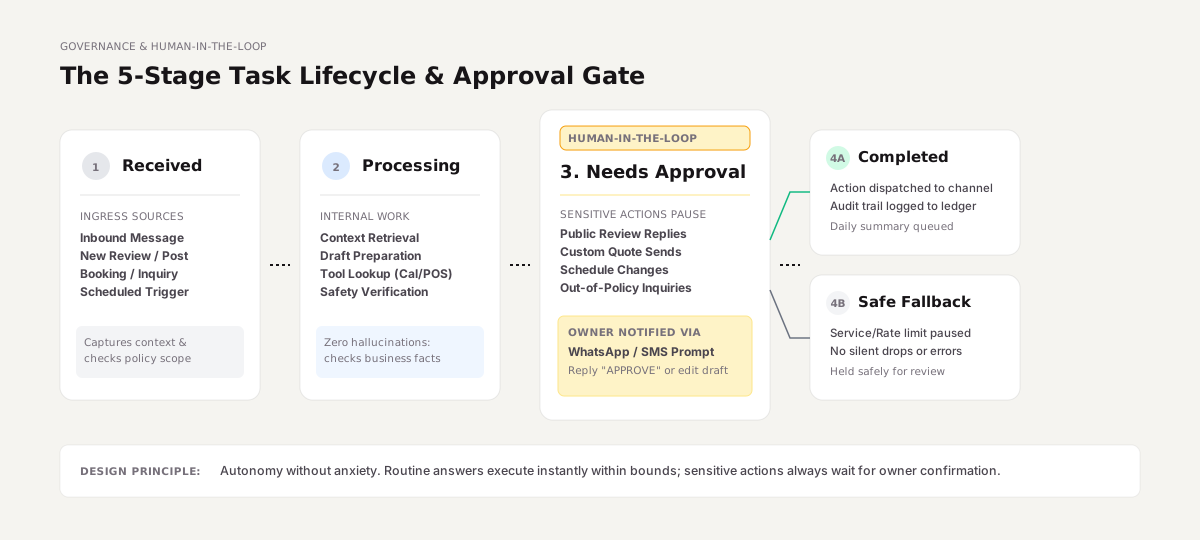
In an autonomous business assistant, predictability is far more valuable than unconstrained capability. Nexus models every business request through an explicit 5-stage task lifecycle:
- 1. Received: Ingress triggers via WhatsApp, SMS, email, or webhook; checks policy scope and loads shared business facts.
- 2. Processing (In Progress): Synthesizes verified context, checks real-time booking/POS tools, and drafts the necessary output with zero external hallucinations.
- 3. Needs Approval (Gate): High-stakes actions (public review replies, custom quote proposals, schedule modifications) pause and send a review card to the owner’s messaging app.
- 4. Completed: Dispatches confirmed actions to the destination channel, logs immutable telemetry, and queues the event for the daily summary.
- 5. Safe Fallback / Paused: Automatically triggered when an external API is down or uncertainty exceeds safe thresholds, holding the item securely for human review.
Managed onboarding: Eliminating software learning curves
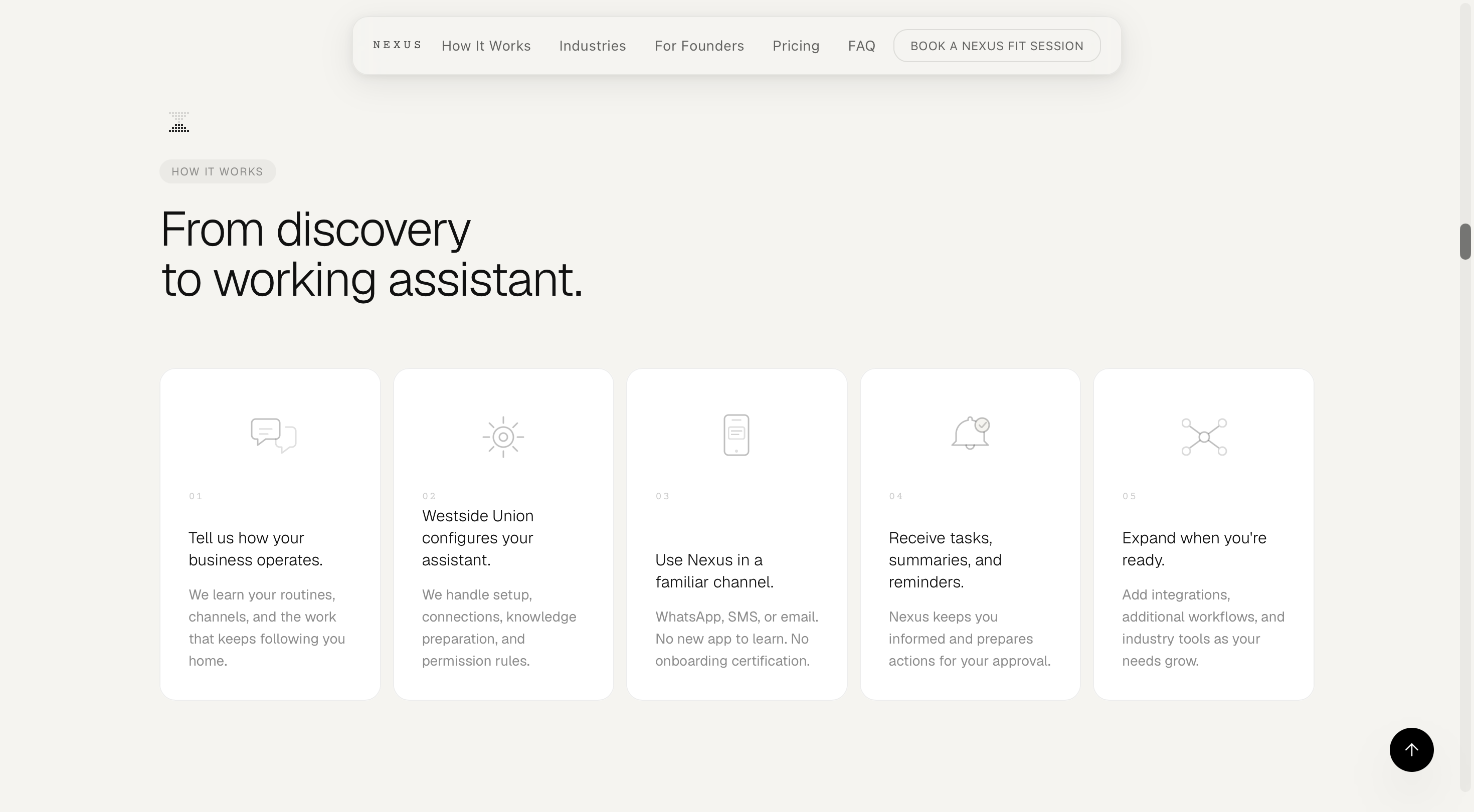
Traditional SaaS products force owners through self-service onboarding wizards, manual schema setup, and tool integration puzzles. Nexus replaces this friction with a managed onboarding service:
Discovery & Workflow Review
We review the owner’s daily routine to pinpoint exactly what steals time—inbound inquiries, booking confusion, review queues, or follow-ups.
Custom Knowledge & Guardrails
Westside Union ingests business policies, operating hours, FAQs, and connects approved channels. We configure strict approval rules and test workflows end-to-end.
Active Managed Assistant
Nexus begins handling agreed work. The owner reviews requests on their phone and receives daily summaries without logging into administrative consoles.
Multi-channel surface & integrations architecture
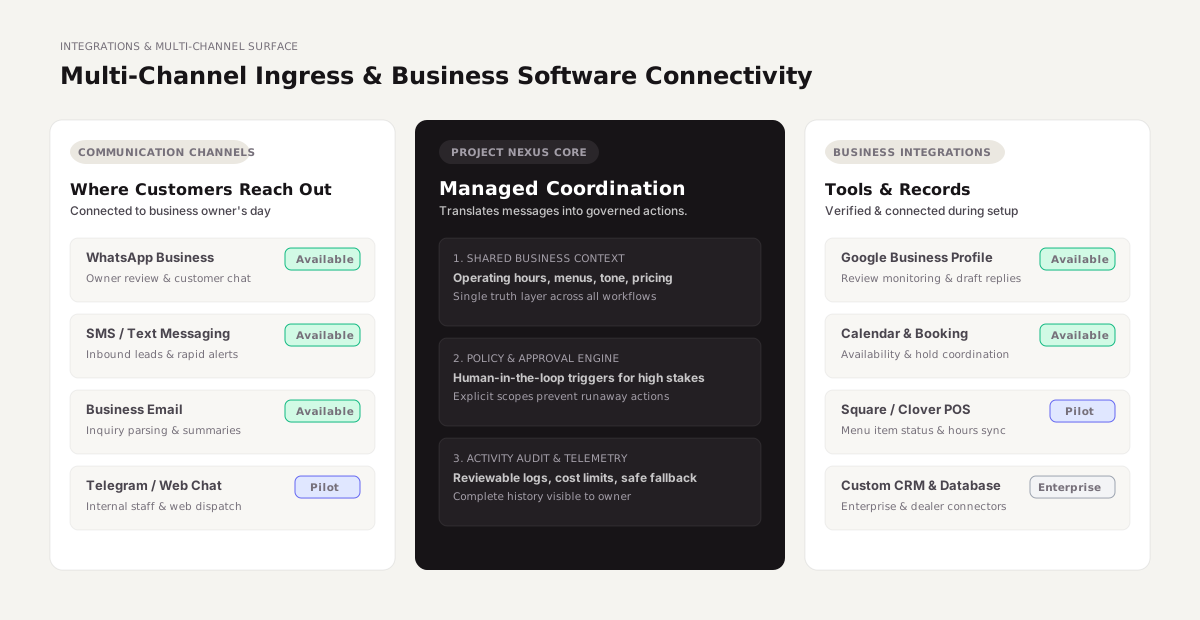
Nexus separates connectivity into two distinct layers:
- Communication Channels (Ingress & Egress): Native touchpoints where customers reach out and owners review actions (WhatsApp Business, SMS / Text Messaging, Business Email, and Web Chat).
- Business Tools & Systems: Verified backend data sources synchronized for real-time validation (Google Business Profile, booking/calendar software, Square/Clover POS, and custom CRMs).
To maintain product honesty, connector readiness is strictly categorized by status: Available, Pilot, or Planned.
Delivery models: Cloud, Edge, and Enterprise
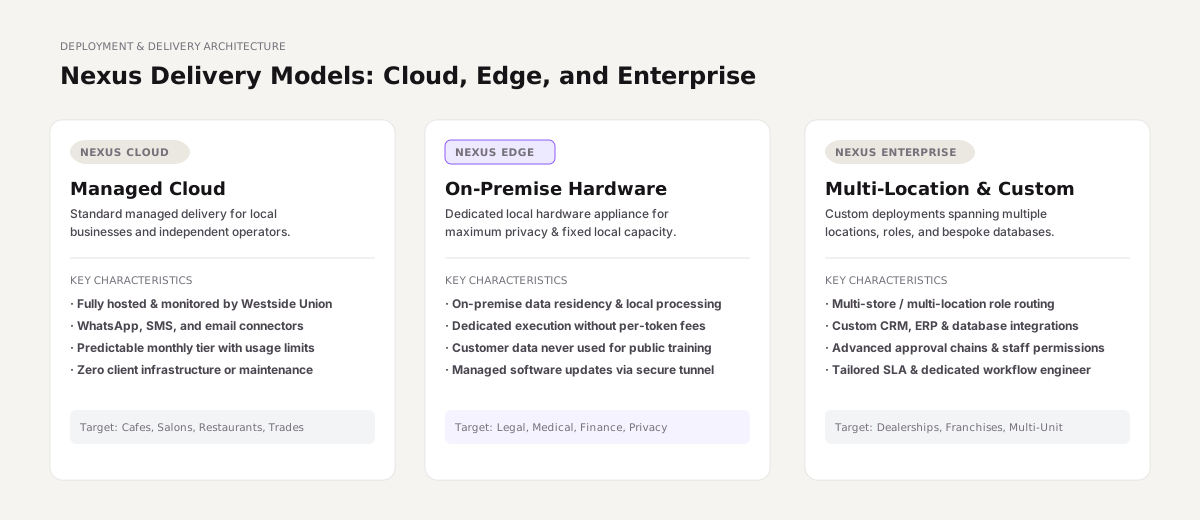
Different businesses operate under different regulatory, privacy, and architectural requirements. Project Nexus is architected to support three flexible delivery tiers:
| Tier | Architecture | Key Value | Target Fit |
|---|---|---|---|
| Nexus Cloud | Fully managed hosted cloud infrastructure | Zero maintenance, predictable monthly tier, instant setup | Cafes, salons, restaurants, trades |
| Nexus Edge | Dedicated on-premise hardware appliance | Local data residency, zero third-party training, fixed capacity | Legal, healthcare, finance, high-privacy |
| Nexus Enterprise | Multi-node / hybrid private cloud deployment | Multi-location routing, custom ERP/CRM hooks, dedicated SLA | Dealership groups, franchises, multi-unit |
Operating assistant dashboard & telemetry visibility
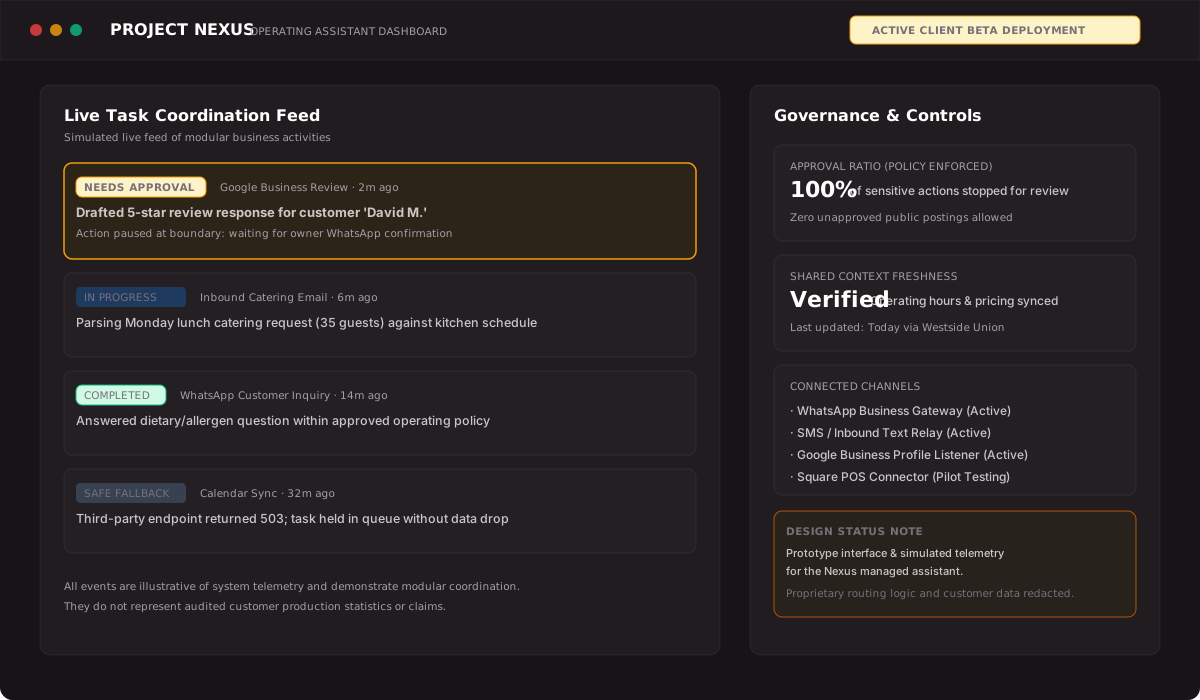
While business owners primarily interact through messaging, the backend operating assistant maintains a structured control center to monitor queue health, review paused approval gates, inspect shared context freshness, and track system telemetry.
The dashboard and live feed reflect working systems operating under an Active Client Beta Deployment. Metrics, response volumes, and activity indicators displayed on demonstration views illustrate real-time telemetry and modular coordination.
Translating technical complexity into human language
A core responsibility throughout the Project Nexus engagement was translating complex distributed AI concepts into calm, credible product language:
| Internal Architecture Concept | Public Product Experience |
|---|---|
| Neutral Agent Control Plane | One managed assistant that coordinates your everyday business work |
| Shared Context & Vector Store | You never have to teach the system your business hours or pricing twice |
| Human-in-the-Loop Policy Gate | Important actions (public replies, quotes) always wait for your approval |
| Graceful Fallback & Circuit Breaker | Tasks pause safely during third-party outages with zero lost work |
| On-Premise Edge Hardware | Private local appliance keeping sensitive data strictly on your premises |
Jacky’s multidisciplinary contribution
As founder and lead product strategist, Jacky drove the project across strategic, architectural, and visual dimensions:
- Product Strategy & Pivot: Identified owner friction through market interviews and directed the strategic evolution from an infrastructure framework to a messaging-first managed service.
- Systems Architecture & Governance: Formulated the 5-stage task lifecycle, human-in-the-loop approval gate, shared context ingestion model, and multi-tier delivery framework.
- Experience & Interaction Design: Designed the WhatsApp/SMS approval cards, onboarding flow, and assistant control center mockups.
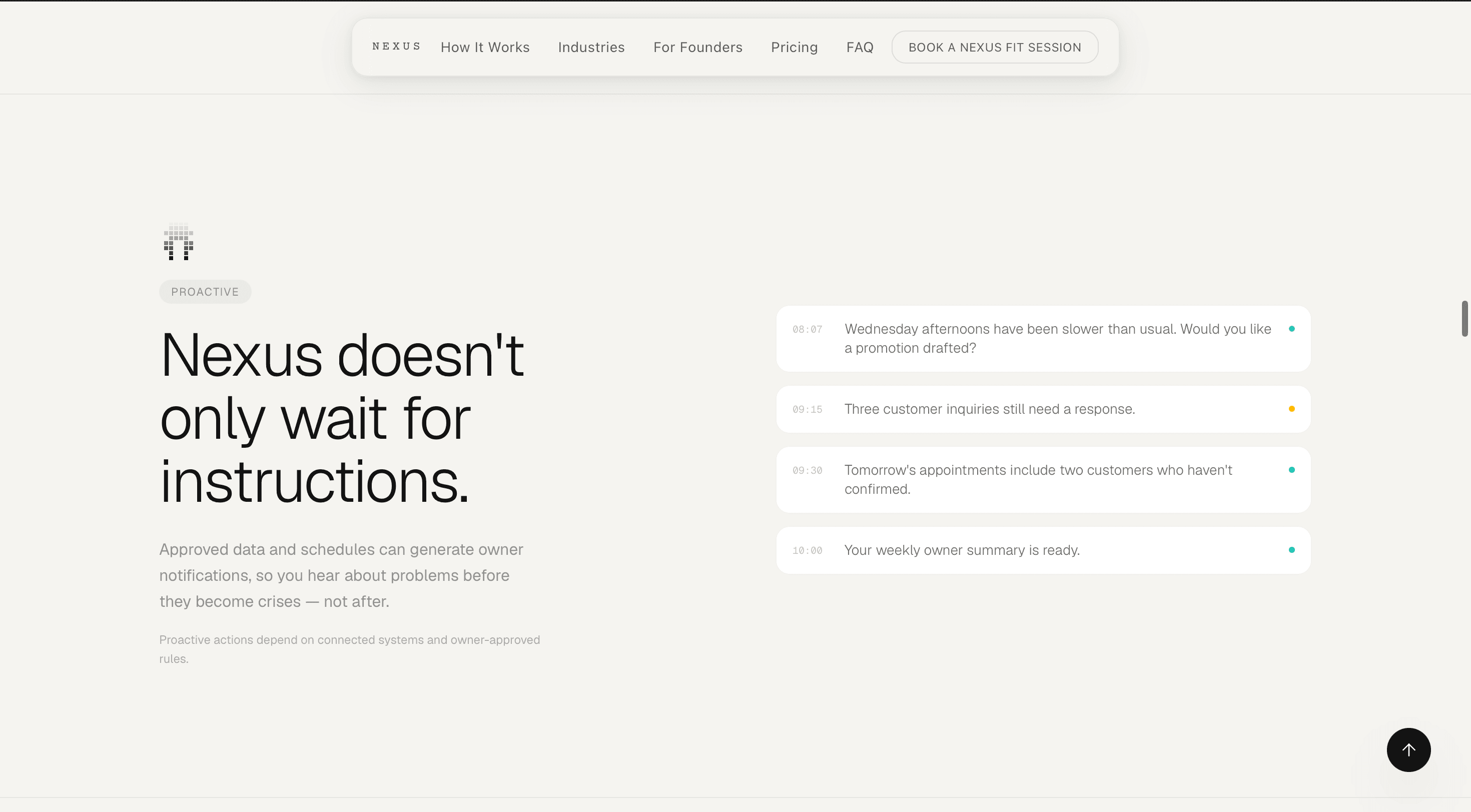
- Creative Direction & Brand Copy: Authored the story-led messaging framework, visual identity, and live marketing experience at
nexus.westside-union.com.
Key takeaways & retrospective
Designing Project Nexus reinforced a fundamental truth about emerging AI products: Technical modularity must be matched with rigorous human governance and radical user simplicity.
By removing the burden of software management from the business owner and embedding intelligent coordination within the communication channels they already use, Nexus demonstrates how sophisticated systems design can turn complex AI capabilities into trusted, everyday business utility.